
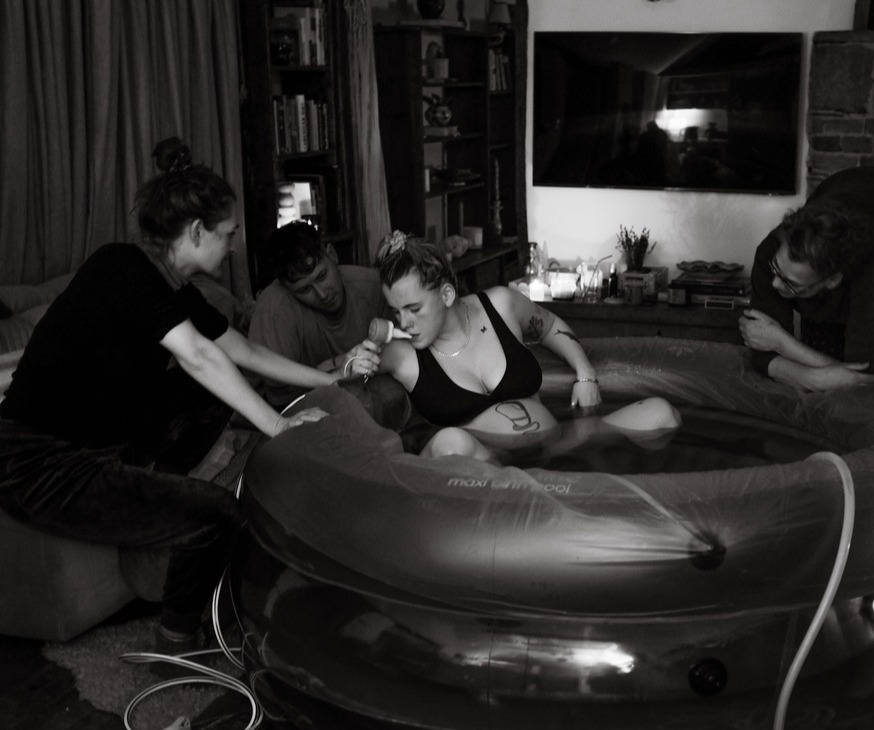
There is something powerful about saying, quietly and clearly, I would like to birth my baby at home.
It is not a guarantee. It is not a promise that birth will unfold in a particular way. And it certainly does not mean that choosing homebirth means you have to be determined to stay at home whatever happens.
For me, an intention is much softer than that.
It is a way of beginning to imagine how you would like to meet your baby. It is giving some thought to what matters to you, what helps you to feel safe, who you want around you and what kind of environment might allow you to feel most at ease.
For some women, that place is home.
As an independent midwife supporting families across East Sussex, Kent and the surrounding areas, I spend a lot of time talking with women about what they are hoping for in birth. Sometimes that is a very clear intention to have a home birth. Sometimes it begins as a quiet curiosity: Could I actually do this at home? Would it be safe? What would it feel like?
I think both are worth exploring.
What does it mean to intend to homebirth?
Planning a home birth is not simply choosing a location.
It is worth asking yourself why home feels important to you.
Perhaps you imagine being in your own space, surrounded by familiar things. Perhaps you want to move freely, eat and drink when you need to, get into your own bath or birth pool, and be able to follow your instincts without feeling watched or hurried.
Perhaps you have had a previous birth where you felt that things happened to you, rather than with you, and this time you want something different.
Perhaps you have read the research, listened to birth stories, spoken to other mothers and simply feel that home is where you would feel most comfortable.
Or perhaps you cannot quite explain it. You just have a feeling that this is where you want to be.
That feeling deserves some attention.
Intention does not mean ignoring the unexpected. It means beginning from a place of thoughtfulness rather than fear.
When I talk to families about home birth, I want to understand what is underneath the decision. What are you hoping for? What are you concerned about? What would help you to feel safe? What would you want to happen if circumstances changed?
Those conversations are part of preparing for birth too.
What does the evidence say about planning a home birth?
The evidence around planned home birth is encouraging, particularly for women with pregnancies where home birth is considered a suitable option.
Research from the Netherlands, involving almost 680,000 low-risk pregnancies, found that women planning a home birth had lower rates of some interventions than those planning a hospital birth. The study found an intervention rate of 10.9% among those planning home birth compared with 13.8% among those planning hospital birth.
Other research has similarly found that planned home birth is associated with fewer interventions such as caesarean birth, instrumental birth and episiotomy in appropriately selected populations.
But I think it is important to be careful with statistics.
Research about place of birth is complicated. Outcomes vary according to the population being studied, the maternity system, the availability of transfer, the definition of home birth and, importantly, whether women were planning home birth from the beginning or simply happened to give birth at home.
So I don't believe in presenting home birth as a magic formula for a straightforward birth.
What I do believe is that where we give birth matters.
The environment around a labouring woman matters. The people with her matter. How safe she feels matters. Whether she feels watched or supported matters. Whether she knows the people caring for her matters.
These things are not separate from physiology. They are part of the environment in which physiology unfolds.
Your nervous system knows where it feels safe
Birth is an extraordinary physiological process.
The hormones involved in labour are influenced by the environment around you. Oxytocin, adrenaline and the other hormones involved in labour are not working in isolation from your surroundings.
If you feel safe, private, unhurried and supported, your body has the conditions it needs to concentrate on the work of labour.
If you feel frightened, observed, rushed or uncertain about the people around you, your body may respond differently.
This is one of the reasons that the environment of birth deserves more attention than simply asking which building you will give birth in.
Home can offer a very different environment from hospital.
You can turn the lights down. You can put on your own music. You can move around your own space. You can climb into your own bed between contractions. You can have familiar food in the kitchen. Your partner can be completely at home too.
None of these things guarantees a particular birth.
But they can create the conditions in which you are able to settle into your own body.
And that is something I value enormously in midwifery.
Intention is not the same as control
One of the things I most want women to understand about planning a home birth is that you do not have to control your birth in order to have a strong birth experience.
Birth can surprise us.
Sometimes a baby takes a different route than we expected. Sometimes labour unfolds slowly. Sometimes there is a concern that needs more monitoring. Sometimes a transfer to hospital becomes the safest option.
None of this means that your intention was wrong.
A home birth plan is not a test that you either pass or fail.
Your intention can travel with you.
If you have prepared for a home birth and circumstances mean that you give birth in hospital, the preparation you have done has not been wasted. You still know more about yourself. You have thought about what helps you feel safe. You have considered your preferences and your boundaries. You have thought about your baby and the kind of beginning you want for your family.
And you can still carry those things with you.
For me, good preparation includes making space for the possibility that things may change.
Not because I expect them to, but because I don't think we need to be frightened of uncertainty.
This is where continuity of care matters
One of the greatest gifts of independent midwifery is continuity.
When you see the same midwife throughout pregnancy, we have time to get to know one another properly.
I get to know how you speak when you are relaxed and how you speak when you are worried. I learn what you are hoping for and what you are frightened of. I know your history, your family, your previous experiences and the things that are important to you.
You get to know me too.
You know how I work. You know how I communicate. You know that you can ask questions. You know that you don't have to agree with me. You know that if I raise a concern, we can talk about it properly.
That relationship becomes particularly valuable when birth doesn't follow the neat plan we had imagined.
Sometimes the right thing is to wait.
Sometimes we need to pause, listen again, check something a little later or simply give your body more time.
That is much easier to do when the person caring for you knows you, knows what is normal for you and understands the wider picture.
Continuity allows us to make decisions in context rather than reacting to every moment in isolation.
What if I am not sure about home birth?
You don't need to be completely certain before you talk to an independent midwife.
In fact, I would much rather you came to me with questions.
What happens if I need to transfer?
What if my blood pressure changes?
What if I go over my due date?
What happens if I need help with the birth?
Can I change my mind?
What happens if I become frightened?
These are all sensible questions.
My role is not to persuade you to have a home birth. My role is to give you clear information, talk through the evidence and the uncertainties, listen to what matters to you and support you in making decisions about your own care.
That might ultimately mean planning a home birth.
It might mean choosing hospital.
It might mean keeping your options open for a while.
And sometimes it means having an independent midwife alongside you for antenatal and postnatal care, even if you are planning to give birth in hospital.
There is no prize for making the “right” choice.
There is only your choice, your baby, your circumstances and the care that feels right for your family.
Beginning with intention
If you are considering a home birth, I would encourage you to spend a little time with the idea before getting caught up in all the practical details.
You might ask yourself:
Where do I feel safest?
What do I want to remember about this birth?
What helps me to trust my body?
What am I afraid of?
Who do I want beside me?
What do I need from the people caring for me?
What would help me feel able to surrender to the process rather than trying to control it?
And perhaps the simplest question of all:
If fear wasn't making the decision for me, what would I choose?
You don't have to have all the answers.
Sometimes intention begins simply with allowing yourself to imagine something different.
Home birth and independent midwifery in East Sussex and Kent
As an independent midwife, I offer personalised antenatal, birth and postnatal care to families across East Sussex, West Sussex, Kent, Surrey and parts of Greater London.
For families planning a home birth, continuity means having a midwife who knows you throughout your pregnancy and is there to support you through labour and the early days with your baby.
I also offer standalone antenatal and postnatal packages for families who are planning to birth in hospital but want continuity, time and individualised care around their pregnancy or the postnatal period.
For me, home birth is not about proving anything.
It is about creating the conditions for a woman to feel safe enough to listen to herself, supported enough to trust her instincts and informed enough to make her own decisions.
Birth may unfold differently from the picture you held in your mind.
That doesn't mean the intention was wasted.
Sometimes the intention is simply the beginning of a much deeper relationship with yourself, your baby and the experience of becoming a mother.